VAWG in Football Culture: Abuse Is Not Part of the Game
Major football tournaments bring people together. They create excitement, community, pride and shared moments that many people look forward to for years.
But alongside the celebration, there is also a difficult reality that cannot be ignored: domestic abuse and violence against women and girls often increase around major football events.
With the 2026 FIFA World Cup taking place from 11 June to 19 July 2026 across Canada, Mexico and the USA, the tournament will be bigger than ever. For many, it will be a month of football, travel, matchday gatherings, pub screenings, fan zones and late nights. While for some people, it may also be a period where existing abuse, intimidation or fear becomes worse.
Football does not cause domestic abuse
Abuse is always a choice made by the perpetrator
But research and policing data have repeatedly shown that the environment around major matches, including heightened emotions, alcohol, gambling, crowd behaviour and tension after results, can act as a trigger or escalation point for existing abusive behaviour.
The data behind football-related abuse
Research by Lancaster University found that:
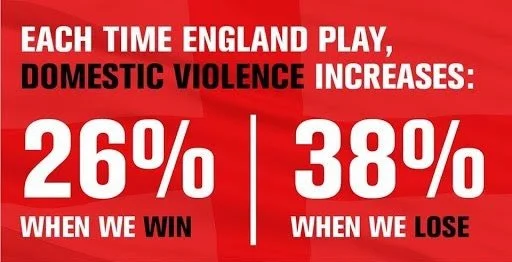
Domestic abuse incidents increased by 38% when England lost a match and by 26% when England won or drew, compared with days when England did not play
Domestic abuse increased by 11% the day after an England match, showing that the risk does not always end when the final whistle blows
Kick It Out research found that:
Over half of women fans (52%) had experienced sexist behaviour or language on matchdays
During the 2024 Euros, the National Police Chiefs’ Council confirmed that:
351 domestic abuse offences related to football were recorded by 43 police forces between 14 June and 14 July 2024
The NPCC made clear that this did not represent all domestic abuse reports during that period, only those where football was recorded as an aggravating factor.
Domestic abuse remains a national issue
Domestic abuse continues to affect millions of people across England and Wales. The Office for National Statistics estimated that 2.3 million people aged 16 and over experienced domestic abuse in the year ending March 2024. This included 1.6 million women and 712,000 men.
Women are disproportionately affected. ONS data for the year ending March 2024 found that 7.4% of women aged 16 to 59 had experienced domestic abuse in the previous year, compared with 3.3% of men.
These figures underline why major tournaments must be treated as more than sporting moments. They are also public safety moments, community safety moments and safeguarding moments.
Why prevention matters
As the World Cup approaches, there is an opportunity for organisations, venues, local authorities, transport providers, police forces, charities, employers and community groups to think ahead.
That means asking practical questions:
Are people able to report concerns safely?
Do staff know how to respond if someone appears distressed or at risk?
Are venues aware of the potential increase in harassment, intimidation or domestic abuse-related concerns?
Are support routes clearly signposted before, during and after matchdays?
Are communities being reminded that abuse is never “just football”, “just drink” or “just emotions running high”?
Prevention doesn’t mean taking enjoyment away from football.
It is about making sure people can enjoy it safely, without fear, intimidation or harm.
imabi and safer reporting routes
At imabi, we believe safety should be built into everyday life, including the moments when communities come together around major events.
Through our partnership with Crimestoppers, we help connect people with trusted information, support and reporting routes. Crimestoppers provides a way for people to give information about crime 100% anonymously, which can be particularly important when someone is worried about speaking up, fears repercussions, or does not know where to turn.
Crimestoppers also recognises that domestic abuse can affect anyone and highlights that many people may feel trapped, isolated or unable to safely access help.
Within imabi’s platform and FREE Travel Guardian app, users can access safety guidance, support services, reporting routes, local information and tools that help them stay connected and informed.


For partners and support organisations, imabi can also support public safety messaging, awareness campaigns, community reporting and signposting around key risk periods such as major tournaments.
Abuse is not part of the game
The World Cup should be a time of connection, celebration and shared experience.
No match result, no rivalry, no frustration and no amount of alcohol excuses abuse, harassment, intimidation or violence.
As we look ahead to the 2026 World Cup, it is important that conversations around football safety include domestic abuse, VAWG, public harassment and the experiences of people who may feel less safe during major sporting events.
When concerns are seen, heard and reported early, communities are better placed to prevent harm before it escalates.