
Starting Uni? Start With Confidence: A Freshers’ Week Guide for Students
Freshers’ Week is often described as one of the most exciting parts of starting university but let’s be honest it can also feel like a lot.
You might be moving away from home for the first time, learning a new city, working out where your lectures are going to take place, meeting new faces, getting to know your flatmates, managing money, going out, getting home, trying to make friends without looking like you’re trying too hard, and so on…
Freshers’ Week is not about having everything figured out straight away - it takes time to find your feet, build confidence, and know what support is around you.
It’s exciting, but it’s also unfamiliar, and that’s completely normal.
Why This Matters
Every year, hundreds of thousands of young people move into higher education. UCAS reported that 279,550 UK 18-year-olds were accepted into university or college in 2024, up 2.9% on the previous year. That means a significant number of students are stepping into new routines, new responsibilities and new environments at the same time.
That transition can also affect wellbeing. TASO’s 2025 student mental health report found that 18.9% of students reported a mental health difficulty, up from 17.9% in 2024 and 6.1% in 2017. The same report notes that mental health remains the leading reason students consider dropping out of university.
Safety is also a live concern for students, particularly around nights out, public spaces and travel. Universities UK has highlighted student safety in the night-time economy as an important area for universities, noting that a joint Our Streets Now and The Tab survey found nearly one in four students had experienced public sexual harassment, rising to 43% of women and non-binary students.
That is why Freshers’ support should not be fear-based, but it should be practical.
Students need clear information, trusted support routes and tools that help them feel confident while they explore new places, meet new people and settle into university life.
Freshers’ Week Is More Than Nights Out
Freshers’ Week is often associated with parties, wristbands and packed student events and for many students, that is part of it.

Freshers’ is also about settling into a new environment. It is the first time many students will need to:
navigate a new campus or city
use unfamiliar public transport
manage their own daily routine
meet lots of new people quickly
make decisions independently
find support without relying on home
That can be a big adjustment: some people love it immediately, others take longer. Some people feel confident in the day but anxious at night, while some enjoy the social side but feel overwhelmed by the pressure to constantly be “on”.
There is no single right way to do Freshers’ Week.
You do not have to go to everything
You do not have to drink
You do not have to make your best friends in the first seven days
You do not have to pretend you’re fine if you’re finding it harder than expected
Get to Know Your New Area
One of the best ways to feel more confident is to understand your surroundings. Before things get too busy, take some time to work out where the basics are:
your accommodation
your main university buildings
the Students’ Union
local shops and pharmacies
bus stops and train stations
GP or health centre
campus security or support services
safe places you can go if you need help
Knowing where things are reduces that “I have no idea where I am” feeling. It also helps when plans change (and during Freshers’ Week, plans often do…)
A cancelled bus, a dead phone, a different venue, a group splitting up, a late-night walk back from somewhere unfamiliar - these moments feel easier when you already have a rough sense of the area.

Plan the Journey, Not Just the Night
Before heading out, ask yourself:
How am I getting there?
How am I getting back?
What’s my backup plan if transport stops?
Do I know where I’m meeting people?
Does someone know where I am?
Is my phone charged?
Student safety in the night-time economy remains a recognised concern across the higher education sector. Planning the journey home is not about fear - it is about making sure the night ends as well as it starts.
A safer night out usually starts before you leave your room.

Stay Connected Without Losing Independence
Starting university often means more independence, and that is a good thing.
Independence does not mean doing everything alone. It can help to have one or two trusted contacts who know roughly what you’re doing, especially when you’re going somewhere new or travelling late.
That could be:
a friend from home
a parent or sibling
a flatmate
someone on your course
a trusted contact in the imabi app
Checking in does not have to be dramatic. It can be as simple as:
“Heading out now” “Got there” “On my way back” “Home safe”
Small messages can make a big difference - for you and for the people who care about you.

Trust Your Instincts
Freshers’ Week can come with pressure.
Pressure to say yes
Pressure to go out
Pressure to drink
Pressure to stay longer
Pressure to act like you’re having the best time of your life
But your comfort matters.
If something feels off, you are allowed to leave
If someone makes you uncomfortable, you are allowed to move away
If you don’t want another drink, you are allowed to say no
If you want to go home early, that is enough reason
You do not need to justify protecting your own wellbeing, and trusting your instincts is not being rude - it is being aware.

Look Out for Each Other
If someone seems lost, overwhelmed, very intoxicated or separated from their group, a simple check-in can help. Ask:
“Are you okay?”
“Do you know who you’re with?”
“Do you want me to help you find your friends?”
“Do you need support?”
Sometimes the smallest intervention can stop a situation escalating.
Know Where Support Is
Every university has support systems, but students do not always know where to find them until they need them. Before Freshers’ Week gets busy, take a few minutes to find out:
how to contact your university wellbeing team
where campus security is based
how to report concerns
who your accommodation contact is
what support your Students’ Union offers
where local urgent help is available
what to do if you feel unsafe on a night out
This matters because higher education providers are increasingly expected to take student welfare, harassment and sexual misconduct seriously. The Office for Students announced new requirements for universities to protect students from harassment and sexual misconduct, while also reporting survey findings that 20% of students had experienced unwanted sexual behaviour.

Digital Safety Matters Too
Freshers’ Week is also a time when people are added to group chats, follow new accounts, share locations, post stories and meet people through apps.
Online and offline safety are connected.
A few simple reminders:
be careful sharing your accommodation location publicly
avoid posting live updates that show exactly where you are
check privacy settings on social media
be cautious with people who pressure you to meet immediately
do not feel obliged to reply to everyone
report or block anyone who makes you uncomfortable
Digital boundaries matter because new connections often start in group chats, social media and dating apps before moving offline. Being careful about location sharing, privacy settings and who can see your updates is part of modern student safety.
How imabi Can Help During Freshers’ Week
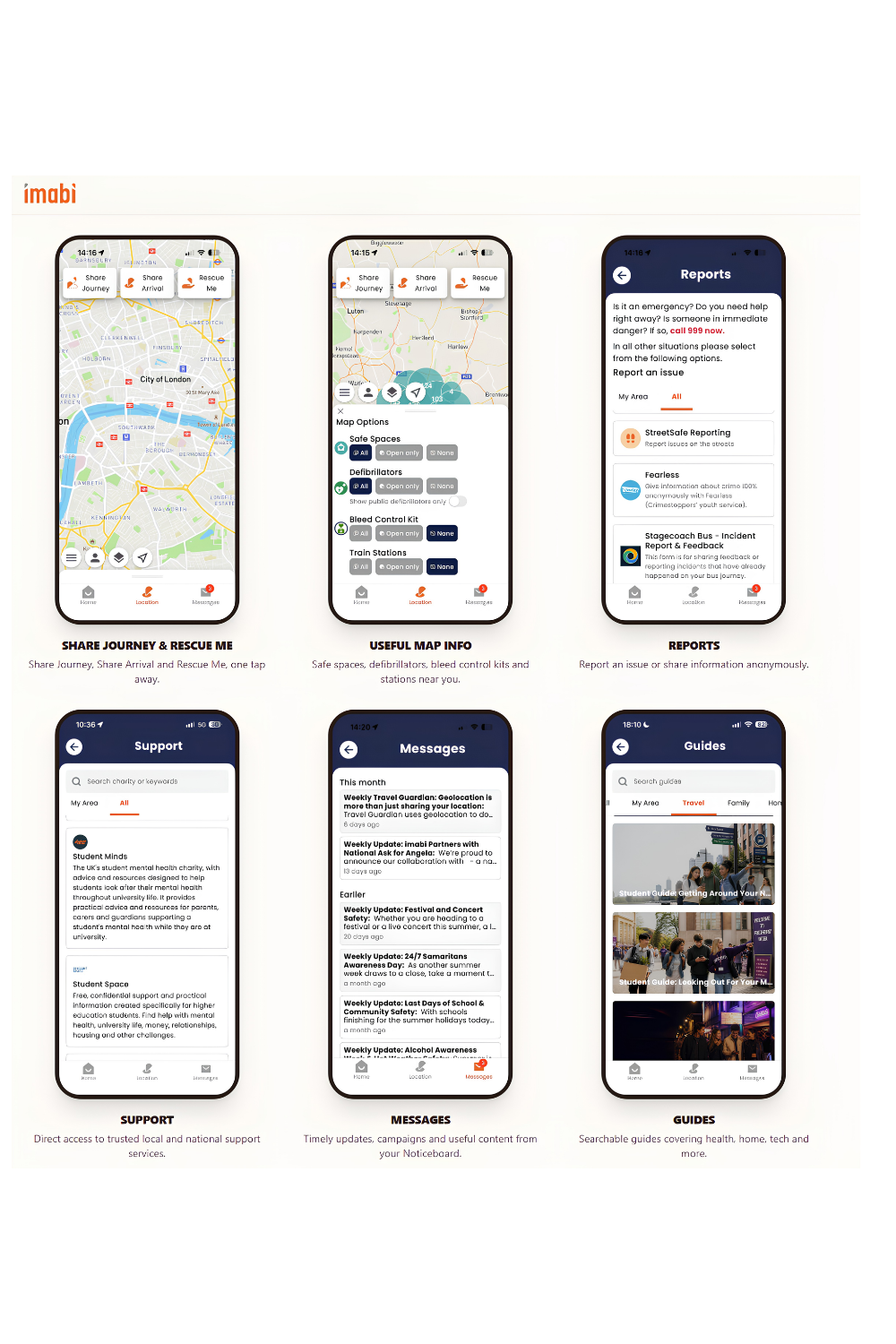
imabi’s Travel Guardian app and the wider imabi platform are designed to help people stay safe, connected and informed in everyday life, including during the move into university.
Through the app, students can access practical tools and information that support confidence, independence and safer decision-making.
This can include:
sharing journeys with trusted contacts
checking in when you arrive
accessing useful safety and wellbeing information
finding mapped support locations and Safe Spaces
seeing relevant guidance through the app
raising concerns or sharing experiences where available
staying connected when plans change


Sources: